Axial - Observations #41
Life sciences reflections

More well thought out work can be found at — https://axial.substack.com/
Axial partners with great founders and inventors. We invest in early-stage life sciences companies often when they are no more than an idea. We are fanatical about helping the rare inventor who is compelled to build their own enduring business. If you or someone you know has a great idea or company in life sciences, Axial would be excited to get to know you and possibly invest in your vision and company . We are excited to be in business with you - email us at info@axialvc.com
Observations #41
A set of ideas and observations from a week’s worth of work analyzing businesses and technologies.
Chemokines
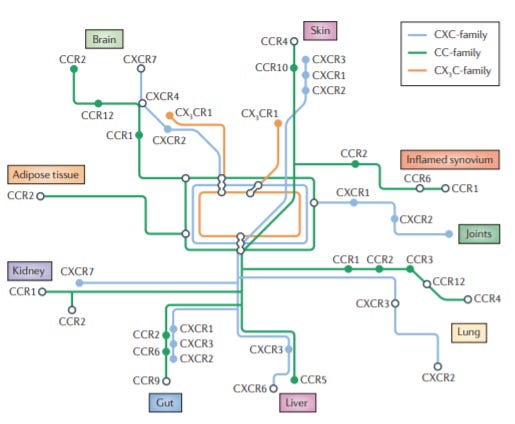
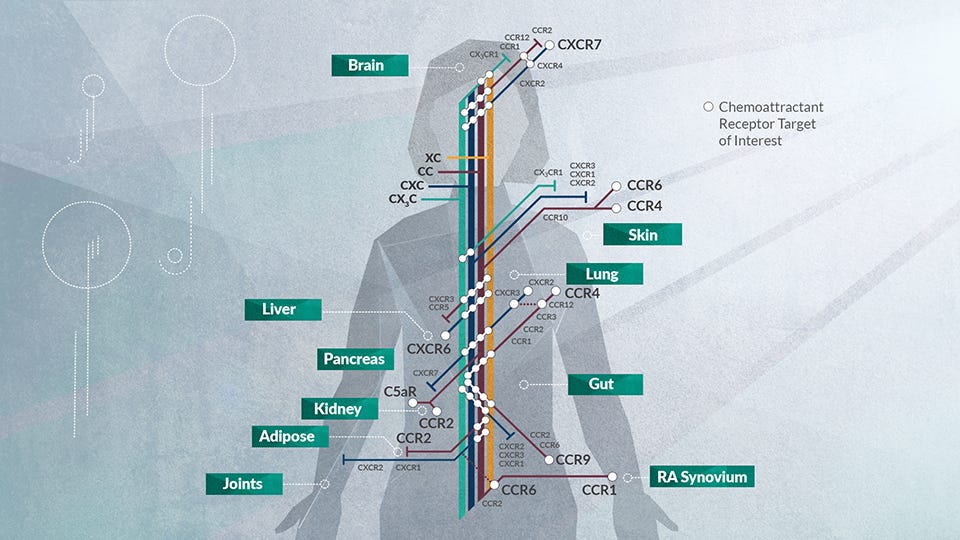
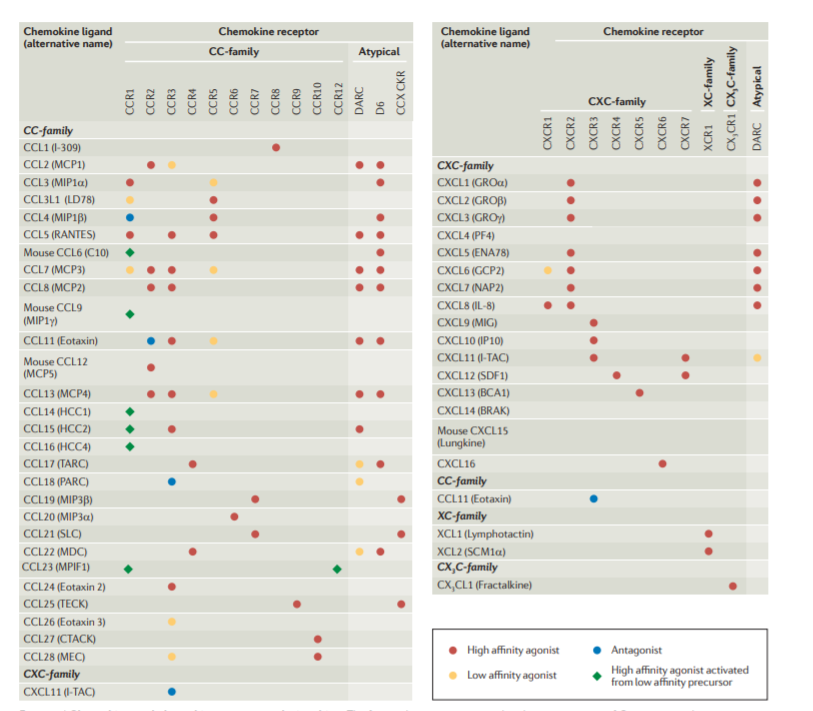
Chemokines are the trafficking control system for the human immune system. They act as signposts to get different immune cells into certain organs. With over 50 different chemokines and 20 receptors (which are GPCRs), they are a class of cytokines that induce chemotaxis in nearby cells.
In 1987, the first chemokine cloned was CXCL8 (IL-8) for work around figuring out what factor(s) monocytes were secreting to attract neutrophils: https://www.ncbi.nlm.nih.gov/pmc/articles/PMC4459227/ & https://www.ncbi.nlm.nih.gov/pmc/articles/PMC4456961/
This sparked large-scale research efforts to clone chemokines and their receptors in the late-1980s and 1990s. This work led to the approval of drugs targeting CXCR4 and CCR5 to treat HIV and C5aR for ANCA-Associated Vasculitis (AAV). Despite the large number of new drug targets for inflammatory diseases generated from this work, dosing and target selection have been barriers for more successful chemokine-focused medicines.
As a result, there is a large opportunity to develop new medicines that target the chemoattractant system: (1) small molecules, as well as antibodies, to selectively target chemokines and their receptors and (2) engineered chemokines:
For autoimmunity, chemokines direct immune cells to self tissue
Viruses and microbes use chemokines to deceive the immune system
Vaccine responses can be improved with chemokines
Chemokines drive inflammatory diseases like AAV, diabetic nephropathy (DN), inflammatory bowel disease (IBD; targeting CCR9), and rheumatoid arthritis (RA; CCR1)
In cancer, angiogenesis is influenced by chemokines
Other diseases like Type 2 diabetes (T2D; CCR2) and chronic kidney disease (CKD) have also been found to be driven by inflammation where chemokines play a major role
The complex orchestration of chemokines and their various interactions with receptors make this space hard-to-drug. Not only does the target matter but the location and time of intervention are important as well. New opportunities with chemokines are centered around target selection for a disease, chemistry, and in vivo dosing:
Mapping in vivo interactions - figuring out systematically which chemokines bind specific receptors and at what doses and locations
Determining the biological response for each chemokine/receptor pair - different chemokines and receptors can have multiple functions depending on tissue, timing, and pairing. Excitedly, a small set of cells with activated chemokine receptors can lead to a large-scale immune response.
Immune cell subsets - which immune cell subsets respond to individual chemokines? For example in monocytes, CCR2 is a marker for an inflammatory class and CX3CR1 is one for the resident subset of monocytes.
Dosing - figuring out dosing in vivo; most work has been in vitro. Moreover, to generate a therapeutic effect, a large proportion of chemokine receptors need to be inhibited continuously, increasing the required critical dose. This requirement can lead to ADMET issues.
Target selection - determining whether a chemokine is redundant or not for a specific disease. For example, CCR7 is activated by both CCL21 and CCL19. Also, CCL5 activates 3 chemokine receptors: CCR1/3/5. Receptor internalization is different for each interaction. Chemokines have been seen as a hard-to-drug class of targets due to this potential redundancy.
Antibodies / engineered chemokines - develop antibodies for specific chemokines or receptors. Targeting chemokines, and using chemokines as a drug, requires knowing the concentration of the ligands in vivo. Pursuing receptors can become complex since they are GPCRs and have multiple transmembrane regions.
There is a large opportunity to bring new chemokine medicines to patients. The low-hanging fruit is to develop models and tools to predict which chemokine/receptor pair is involved in disease and develop a drug candidate to target the pair. In short, new methods are needed to figure out which part of the control system to block or add to?
The AgBiome Model
AgBiome is a large Agtech company with no managers. Rather, the company uses committees of employees to handle core functions like business development and financials. Eric Ward, Co-Founder and Co-CEO, took the lead to build this unique organizational structure at AgBiome - https://insights.som.yale.edu/insights/can-company-succeed-without-hierarchy
Their ideas started off with a management paper - https://cmr.berkeley.edu/search/articleDetail.aspx?article=4776 - to build a non-hierarchical structure at the startup. AgBiome might have the most unique operational structure in life sciences.
Jacob and Monod, and mRNA
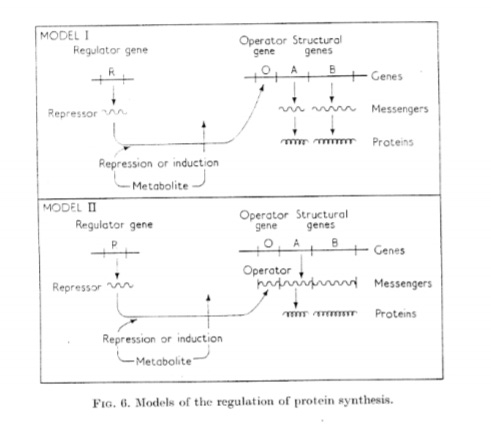
With the first authorizations of two mRNA vaccines for COVID-19, mRNA is set up to transform medicine over the next few decades. Decades ago in 1961, Jacob and Monod first hypothesized what mRNA could be - https://www.gs.washington.edu/academics/courses/braun/55106/readings/jacob_and_monod.pdf
What is Life? cont.
In the final chapter (Is Life Based on the Laws of Physics?) of What is Life?, Schrödinger explores how life can emerge from the randomness of physics. The chapter focuses on two frameworks: (1) order-from-order (the traditional physics framework) and (2) order-from disorder (life):
“In biology we are faced with an entirely different situation. A single group of atoms existing only in one copy produces orderly events, marvellously tuned in with each other and with the environment according to most subtle laws. I said, existing only in one copy, for after all we have the example of the egg and of the unicellular organism. In the following stages of a higher organism the copies are multiplied, that is true. But to what extent? Something like 1014 in a grown mammal, I understand. What is that! Only a millionth of the number of molecules in one cubic inch of air. Though comparatively bulky, by coalescing they would form but a tiny drop of liquid. And look at the way they are actually distributed. Every cell harbours just one ofthem (or two, ifwe bear in mind diploidy). Since we know the power this tiny central office has in the isolated cell, do they not resemble stations of local government dispersed through the body, communicating with each other with great ease, thanks to the code that is common to all of them?”
“The orderliness encountered in the unfolding of life springs from a different source. It appears that there are two different 'mechanisms' by which orderly events can be produced: the 'statistical mechanism' which produces 'order from disorder' and the new one, producing 'order from order'. To the unprejudiced mind the second principle appears to be much simpler, much more plausible. No doubt it is. That is why physicists were so proud to have fallen in with the other one, the 'order-from-disorder' principle, which is actually followed in Nature and which alone conveys an understanding of the great line of natural events, in the first place of their irreversibility. But we cannot expect that the 'laws of physics' derived from it suffice straightaway to explain the behaviour of living matter, whose most striking features are visibly based to a large extent on the 'order-from-order' principle. You would not expect two entirely different mechanisms to bring about the same type of law - you would not expect your latch-key to open your neighbour's door as well.”
Aaron Sloman does a great job summarizing What is Life? as well - https://www.cs.bham.ac.uk/research/projects/cogaff/misc/schrodinger-life.html